The Non-Gravitational Acceleration of 3I/ATLAS
When non-experts hear that "Comet 3I/ATLAS has non-gravitational
acceleration," some think it means the interstellar object must
be a spaceship. Not so. All comets have non-gravitational acceleration.
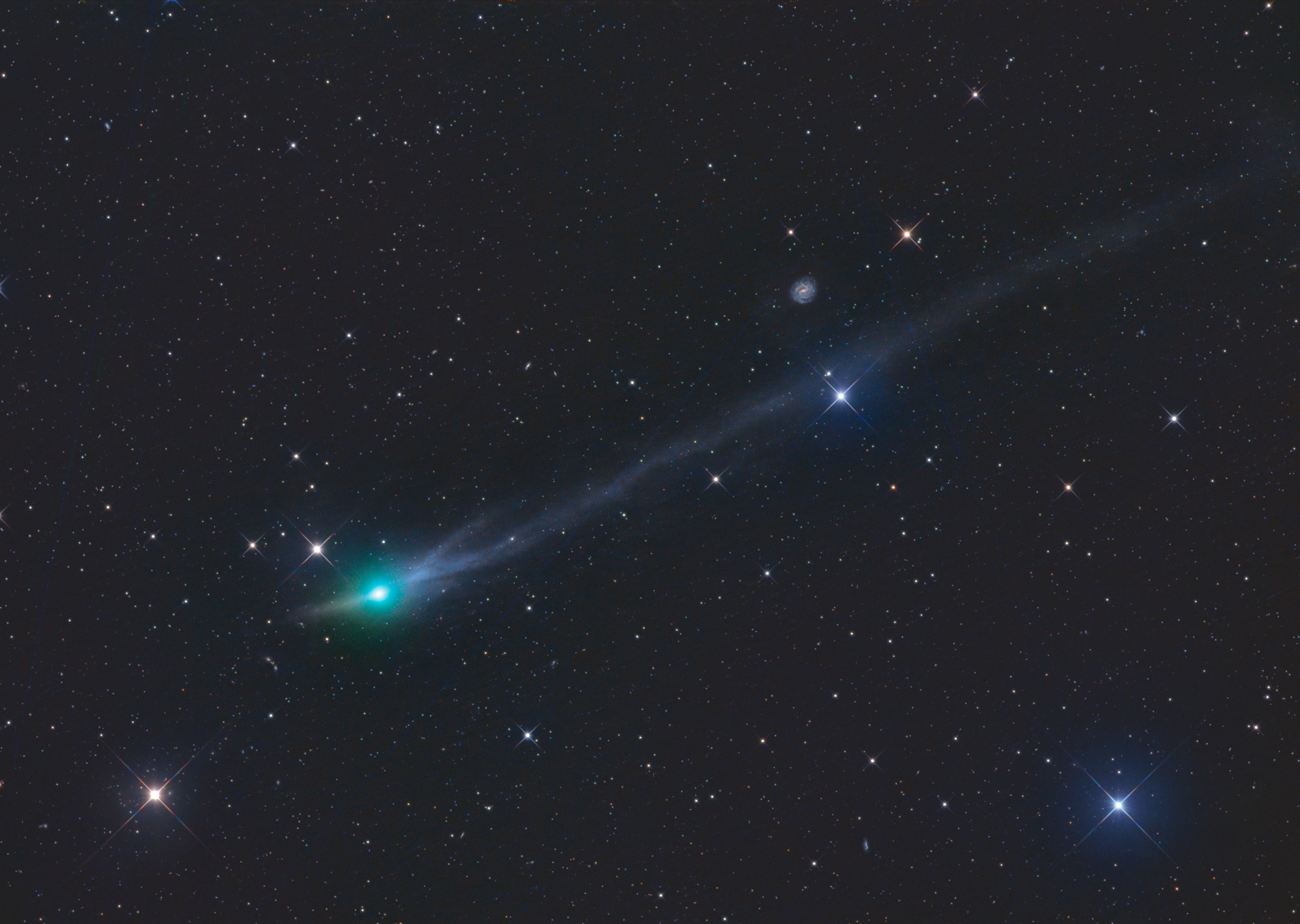
Comet 3I/ATLAS photographed Dec.2, 2025, by Gerald Rhemann and Michael Jäger
A new paper published in Research Notes of the AAS explains why--and shows how 3I/ATLAS behaves very much like the comets we know from our own Solar System.
“We measured the non-gravitational acceleration of 3I/ATLAS using long-baseline astrometry from NASA’s Psyche spacecraft and ESA’s Mars Trace Gas Orbiter,” explains lead author Marshall Eubanks. “The results are pretty typical of ordinary comets, and certainly not record-breaking.”
Non-gravitational acceleration comes from the gentle push comets experience from their own outgassing. Jets of icy material sublimating from the nucleus recoil like tiny rocket engines, nudging the comet off the path it would follow under gravity alone.
"Until recently, finding non-gravitational accelerations in comets required observations over multiple orbits--which we will never have for interstellar objects," says Eubanks. "Now, using interplanetary spacecraft, we can measure these small accelerations--just a few hundred millionths of Earth’s gravity--during a single flythrough of the solar system."
For 3I/ATLAS, the acceleration caused by outgassing is about 5 × 10⁻⁷ m s⁻², comparable to that of many small Solar System comets. Using this value, along with measurements of carbon dioxide production, the team estimated the comet’s mass at about 44 million metric tons and its radius between 260 and 370 meters--again, entirely typical.
The comparison between 3I/ATLAS and the original interstellar object 1I/‘Oumuamua is striking. In 2017 when 1I/‘Oumuamua was passing through the Solar System, its non-gravitational acceleration (~10⁻⁶ m s⁻²) attracted attention. Why? Because ‘Oumuamua didn't have any obvious outgassing. This laid the foundation for Avi Loeb's claims that 1I/'Oumuamua might be a light sail or some other kind of tech.
3I/ATLAS, on the other hand, seems normal. It has obvious cometary outgassing with a non-gravitational acceleration to match. Claiming that it, too, is a spacecraft does not fit the data.
Conclusion: 3I/ATLAS is exotic and wonderful. It is also a comet.